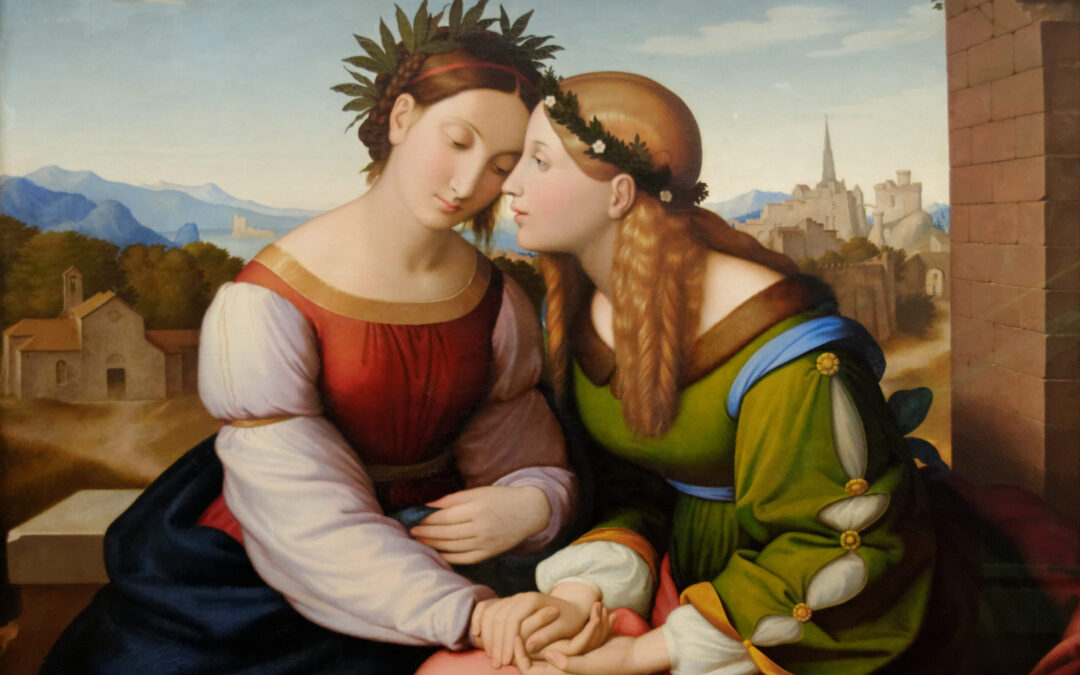
Italia und Germaina by Friedrich Overbech, symbolizing the 19th-century German fascination with all things Italian and –– by extension –– Catholic.
Concert
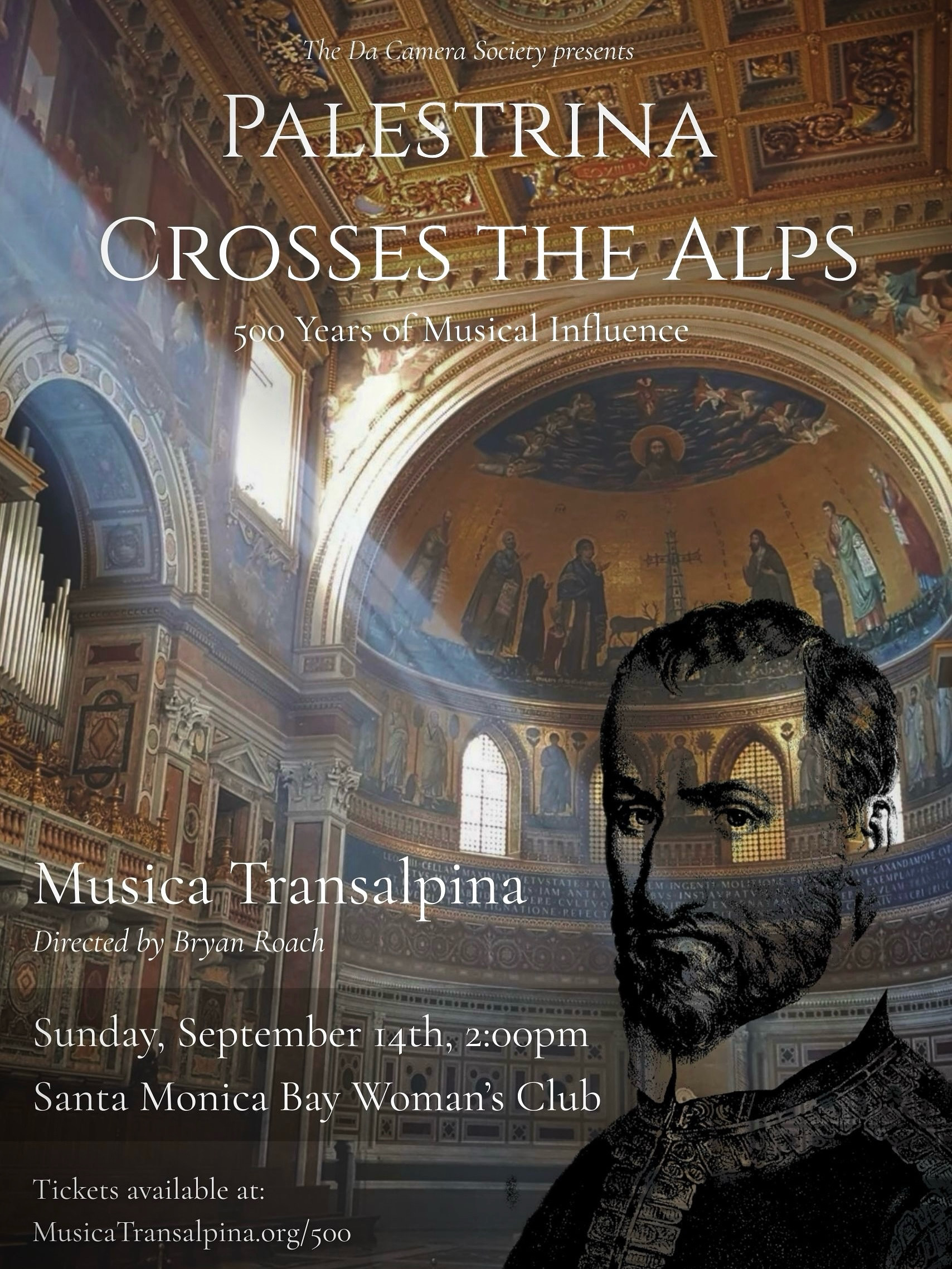
Sunday September 14, 2025 at 2 P. M.
Santa Monica Bay Woman’s Club
1210 Fourth Street
Santa Monica, CA 90401
The Year 2025 marks 500 years since the birth of Giovanni Pierluigi da Palestrina, who is considered the first truly great composer. Unlike Bach, Palestrina’s works have been performed consistently ever since he was alive. Palestrina worked closely with the popes in Rome, and the implementation of his musical reforms changed the course of music history forever.
Humanists during the Renaissance perceived several flaws in the way that music was composed during the sixteenth century (for instance, long melismatic passages on weak syllables, as well musical phrases that seemingly failed to adequately emphasize the rhetorical imagery of the words), which were corrected by Palestrina and his contemporaries, laying the foundation for the Baroque. Palestrina’s style would reach legendary status during the seventeenth century, and it has been performed continuously over the past 450 years, inspiring countless revival movements ever since.
To reflect Palestrina’s timeless legacy, we have programmed compositions that illustrate how the concept of Palestrina’s music evolved over the centuries: we begin with late 16th- and early 17th-century adaptations of Palestrina’s works for solo voice in a nascent baroque idiom, followed by compositions from the 18th & 19th centuries by German composers directly imitating Palestrina’s style, including a transcription of a Palestrina mass arranged by Bach himself.
Program
Palestrina – Dum complerentur (pub. 1569; organ part added circa 1585.)
Palestrina – Pater noster (1575)
Intabulation of the Pater Noster by Paix, pub. 1583.
Palestrina – Ave Maria (1563)
Divisions upon Ave Maria by Bassano, 1591.
Palestrina – Pulchra es (1584)
Divisions upon Pulchra es by Rognoni, 1621.
Lotti – Crucifixus from the Credo in F Major (c. 1717)
Fux (died 1741) – Beati omnes (pub. 1859)
Intermission
Frescobaldi – Capriccio sopra Vestiva i colli di Palestrina (c. 1643)
Palestrina – Missa sine nomine (1591) transcribed by J. S. Bach (c. 1742)
Palestrina – Offertorium in Dominca XIII. post Pentecosten (1593.)
Mendelssohn – Im Advent, No. 5 from Sechs Sprüche, Op. 79 (1846)
Bruckner – Os Justi (1879)
Personnel
Graycen Gardener, soprano primo
Dr. Alexander Bonus, cornetto primo
Anna Schubert, soprano secondo
Dr. Carlo Benedetti, cornetto secondo
William Duffy & Nathaniel Decker, alto
Brad Close, alto sackbut
Dr. R. Matthew Brown, tenore primo
Nick Daley, tenor sackbut
Luc Kleiner, tenore secondo
Eric Schmalz, tenor sackbut
John Buffett, basso
Noah Gladstone, bass sackbut
Continuo:
Gabriel Golden, violone
Cono “Richard” Savino, theorbo
Sean Maxwell, organo
Bryan Roach, maestro di capella