
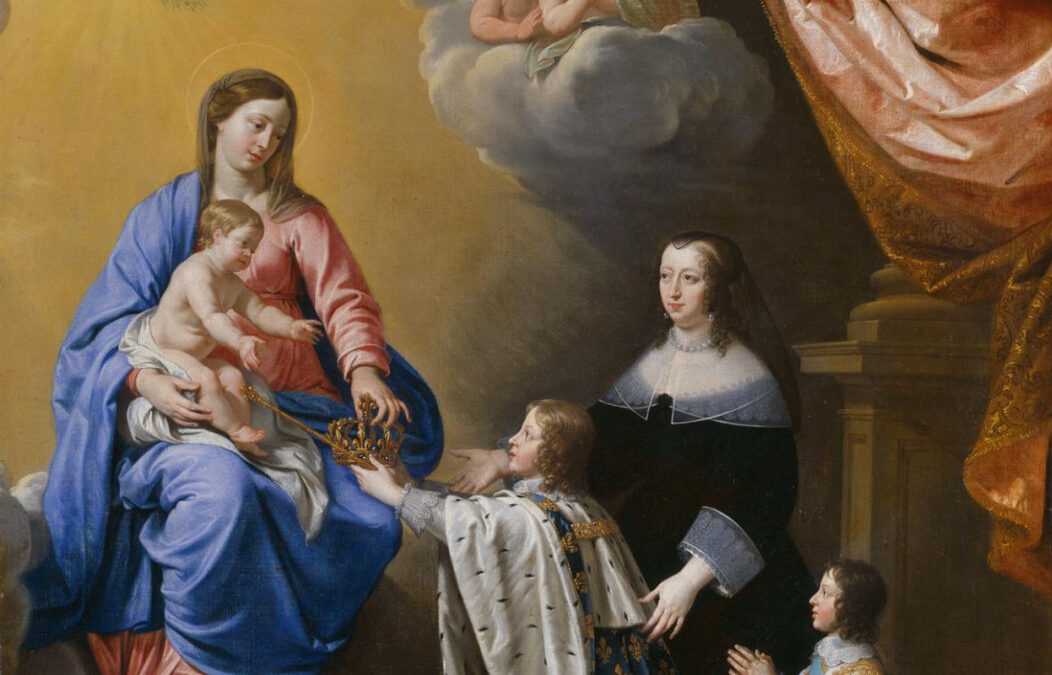
Louis XIV. consecrates his crown & sceptre to the Mother of God by Philippe de Champaigne (1643), courtesy of the Hamburger Kunsthalle.
Saturday October 10, 2026 at 7.30 P. M.
The Parish Church of St. Andrew
311 North Raymond Avenue
Pasadena CA 91103
Free parking in the lot diagonally across from St. Andrew’s.
Sunday October 11, 2026 at 4 P. M.
St. Mark Church
2200 San Joaquin Hills Road
Newport Beach CA 92660
Sacred music during the Age of Absolutism played an indispensable rôle in helping a ruler convey an image of piety, prestige, and power. While the Holy Roman Empire was busy combatting heresy with resplendent polychoral music in a highly Italianate style, the French court––beginning with Louis XIII. and continuing with even greater majesty during the reign of Louis XIV.––promoted highly idiosyncratic liturgical music that had less to do with Romanitas and more to do with reinforcing the idea that France, as “Eldest Daughter of the Church”, was unique among Christian nations and therefore deserving of a distinctly Gallican musical style.
The liturgical sensibilities of seventeenth-century France were notoriously lax, with a preference for grands motets performed during low masses & paraliturgies like Benediction, compared to settings of the mass ordinary intended for high mass, which were preferred by the Austrian court. Eventually (and sometimes controversially), these opulent sacred compositions made their way into secular spaces, in particular with Le Concert Spirituel, a concert series of sacred music produced during the season of Lent, when other forms of musical entertainment like opera were forbidden.
Musica Transalpina pays homage to the opulent sacred music of the French court which formed the basis of the first public concert series, featuring large-scale compositions by Campra, Delalande, and other composers which could have been heard during low mass at the chapel royal in Versailles, or at a concert in the Salle des Cent Suisses in the Tuileries.