
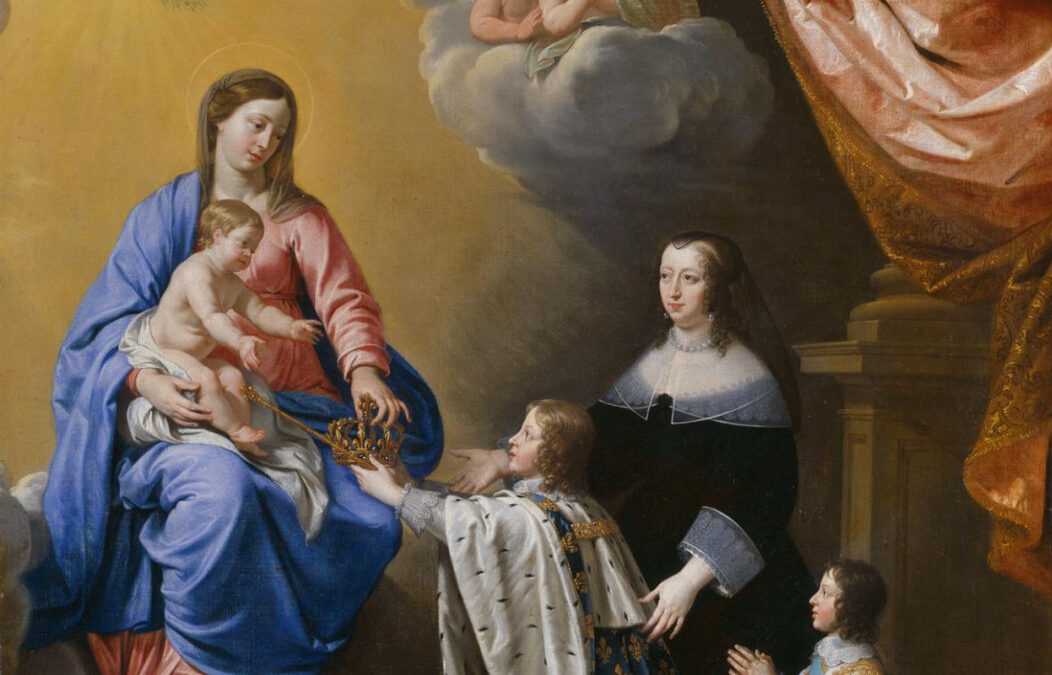
Louis XIV. consecrates his crown & sceptre to the Mother of God by Philippe de Champaigne (1643), courtesy of the Hamburger Kunsthalle.
Saturday September 26, 2026 at 7.30 P. M.
The Parish Church of St. Andrew
311 North Raymond Avenue
Pasadena CA 91103
Free parking in the lot diagonally across from St. Andrew’s.
BEYOND VERSAILLES: FORGOTTEN MASTERPIECES OF THE FRENCH BAROQUE
Musica Transalpina baroque ensemble
Bryan Roach, director.
Eric Tinkerhess, special guest conductor.
PROGRAMME
MARC-ANTONIE CHARPENTIER
Messe à 8. voix et 8. violons et flûtes, H. 3
Elevation O Salutaris Hostia, H. 236
Domine salvum fac regem, H. 283
Motet pour S. François de Borgia, H. 354
FRANÇOIS COUPERIN
Selections from the Messe a l’usage ordinaire des paroisses, pour les Festes Solemnelles (pub. 1690)
FRANCESCO FOGGIA
Offertory Veritas mea (pub. 1681)
• • •
Plainchant from the Graduale juxta missale Parisiense (pub. 1662)
NOTES
Performances of French baroque music are infrequent in the United States, and to the extent that large-scale French compositions from this period are programmed, they tend to concentrate – almost exclusively – on music from Versailles.
On Saturday September 26, 2026, Musica Transalpina is proud to present a program of large-scale sacred works from an overlooked source: the music of baroque-era Paris. Since performances of large-scale works from this period are rare enough, a concert of French ceremonial music originating outside of the Court constitutes the rarest of the rare.
Sacred music during the Age of Absolutism was seen as an indispensable tool to convey an image of piety, prestige, and power, but the preferred idiom of the Court – the opulent grand motet – was harshly criticized beyond Versailles as being overly theatrical, bombastic, and disconnected from the liturgy. Conversely, the music of provincial churches was derided by contemporary elites as being old-fashioned and austere, with an inordinate emphasis placed on Gregorian plainchant. The exception to this derision – and perhaps a via media – was the music of the great Parisian churches, which were simulatneously liturgically conservative while seamlessly integrating sacred masterpieces by great composers such as Charpentier, Campra, and Couperin.
The Society of Jesus was established by seven Spaniards studying at the University of Paris in the year 1534, and in the coming decades they enthusiastically spread both baroque architecture and baroque church music north of the Alps in order to promote Italian culture during the Catholic Counterreformation. Their Parisian headquarters, the Eglise Saint-Louis, became renowned for its lavish music program, famously employing Charpentier, Campra, and even Rameau. Interestingly, this church was the first baroque building in France – as well one of the first Parisian buildings to feature a dome – permanently reshaping not only the city’s skyline, but indeed the city’s musical landscape.
Musica Transalpina is proud to present a mass setting by Charpentier which was commissioned to celebrate a very important religious event – and was most likely commissioned by the Jesuits – around the year 1670. This mass combines Charpentier’s love for Italian polychoral sacred music with a uniquely French orchestration. Performances of Charpentier’s mass settings are an unusual treat in the United States, and we are confident that this event will be a unique musical experience for all in attendance!